

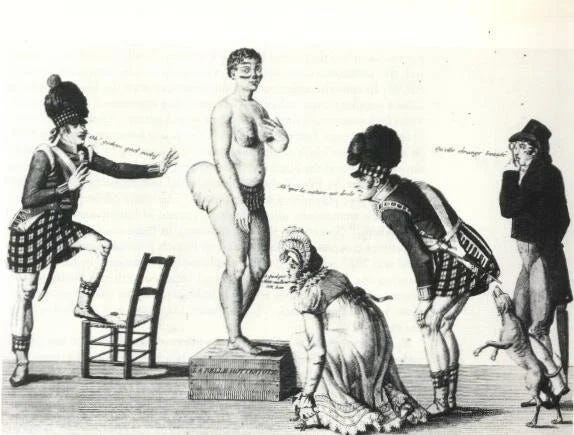
Image: An early 19th century print that depicts Sara Baartman on display (after Baker 2006, p. 12).
When I decide I want to write about the person I’m going to write about here, I meet a sticky problem immediately. I have known about her for a long time, because of my interest in early nineteenth century circus culture, but I don’t know her name. Not her real name anyway. Even as I write, I realise that calling her ‘The Hottentot Venus’ is not appropriate. But neither are any of the variants of the name she was given: Saartjie Baartman, Sara Baartman, Sarah Baartman, Saartje Baartman, Sara Bartmann, Sartjee Baartman. Her real name doesn’t exist in our knowledge systems, because as a Khoikhoi woman sold into enslavement from southern Africa and exhibited in Britain and France, her true name has been erased from the history books and any collective memory. But her body, the body of a woman exploited and touted as spectacle, that has remained in our consciousness.
So I will call her Sarah Baartman, knowing that even as I do so, I am still treating her as an object to be defined by a world that doesn't know her.
This story starts in Europe with the expansion of European colonial empires, the growth of the transatlantic slave trade and increased encounters between Europeans and the rest of the world. It is fair to say it is clear now that this age was driven and supported by intellectual justifications for conquest and enslavement. The very idea of racial hierarchy begins here, alongside the inexorable surge of imperial conquest. Scientific institutions that we still venerate today created and reinforced the idea of race to serve a colonial purpose.
How does Sarah Baartman fit into this story? What little is known of her life before she became ‘Sarah Baartman’ fits into this paragraph. She was born into the Dutch colony of South Africa, a Khoikhoi woman. The Khoikhoi were termed ‘Hottentots’ by the Dutch, allegedly because the name mimics the sound of their language. We know that she was orphaned early in her life; she survived by working on Dutch farms, eventually working in Cape Town as washerwoman and as a wet nurse.
Hers is a story of betrayal and exploitation. Her first ‘employer’ introduced her to Alexander Dunlop, a ship surgeon, who took her to England. There is some debate as to whether she was coerced, or whether she went willingly. In any case, she was illiterate and not in any position to truly understand what she was intended for in England. Dunlop displayed her at Piccadilly Circus, labelling her the ‘Hottentot Venus’.
You might think this sounds incredibly flattering, but the truth lies in colonists’ views of the female Black body. Sarah’s body was seen as unusual, possibly even grotesque, and certainly a stark counterpoint to the perception of refined proportional European female figure. Sarah is said to have had steatopygia, a large accumulation of fat on her buttocks. She is also said to have had elongated genitals, described by the European gaze as the ‘Hottentot apron’. She was a spectacle, one to be gawked at and jeered at. She was an exhibit, akin to an animal in a zoo. And with this horrifying fascination, her viewers were also buying into an idea that still exists today: that of the African female body as highly primitive and sexualised.
Her body was seen as hard evidence of racial difference. Her body signalled African atavism, a hyper sexual counterpoint to the pure white woman, the ‘other, a monster and a novelty. She was exhibited publicly, but people could pay to see her body privately. She quickly caught the attention of physicians, anatomists and naturalists. Her body became something to be measured, and observed, in the pursuit of the pseudoscience of race and racial groups. Race science was obsessed with measuring and categorising the human body, and placing it into a hierarchy with white at the top and Black at the bottom.
Georges Cuvier was one such ‘scientist’. A naturalist by trade, he travelled to see Sarah and to draw her. When Sarah died, possibly of tuberculosis or pneumonia, the scrutiny she experienced didn’t stop there. Even in death, her body was exploited as scientific evidence. Cuvier dissected her, took a mould of her body and created a death mask. Parts of her body were then sent to museums, so she continued to be an object even after she had passed.
It is hard to describe the aftermath of Sarah’s life as a happy ending. Activists campaigned fiercely for the return of Sarah’s body to her ancestral homelands and finally, in 2002, she came home and was granted a State funeral. This act of recognition doesn’t erase her suffering, but it does provide, as a coda, a symbolic restoration of dignity and perhaps even a recognition of historical harm.
Artists have tried to give her a voice, and have tried to represent her body in many different ways. In some sense, she is still a figure to be observed. For us, as teachers and educators, we can see her as the epitome of what happens when individual prejudice is translated institutionally, in the fields we study today.
References
Abrahams, Yvette. “Images of Sara Baartman: Sexuality, Race, and Gender in Early Nineteenth-Century Britain.” Agenda, no. 40, 1998, pp. 220–236.
Bernasconi, Robert, editor. The Idea of Race in Science: Great Britain 1800–1960. Routledge, 2003.
Crais, Clifton, and Pamela Scully. Sara Baartman and the Hottentot Venus: A Ghost Story and a Biography. Princeton UP, 2009.
Cuvier, Georges. Extrait d’Observations Faites sur le Cadavre d’une Femme Connue à Paris et à Londres sous le Nom de Vénus Hottentote. 1817.
Fausto-Sterling, Anne. “Gender, Race, and Nation: The Comparative Anatomy of ‘Hottentot’ Women in Europe, 1815–1817.” Deviant Bodies: Critical Perspectives on Difference in Science and Popular Culture, edited by Jennifer Terry and Jacqueline Urla, Indiana UP, 1995, pp. 19–48.
Gilman, Sander L. “Black Bodies, White Bodies: Toward an Iconography of Female Sexuality in Late Nineteenth-Century Art, Medicine, and Literature.” Critical Inquiry, vol. 12, no. 1, 1985, pp. 204–242.
Gould, Stephen Jay. The Mismeasure of Man. Rev. ed., W. W. Norton, 1996.
Holmes, Rachel. African Queen: The Real Life of the Hottentot Venus. Random House, 2007.